
- This event has passed.
Mortal Matters
Free and open to all
September 19th , 10:00am – September 20th , 7:00pm
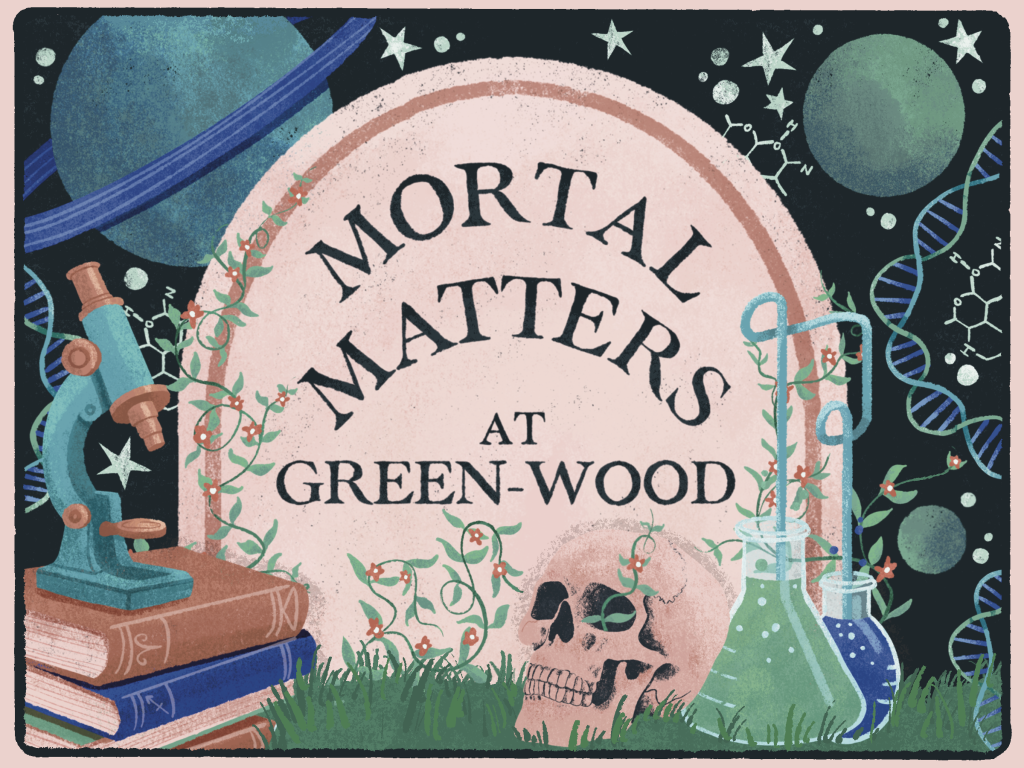
Grief is deeply rooted in our shared human story. But mortality isn’t just a human experience; it’s woven into the fabric of the universe itself, where stars are born and die, and galaxies collide and dissolve. What happens on Earth happens in the cosmos, too.
Mortal Matters is an invitation to sit with that truth. Through talks, workshops, and guided tours, we’re weaving together three ways of understanding life’s end: the practice, the science, and the story. End-of-life and funeral professionals share what they know from the front lines of loss. Astrophysicists, cultural anthropologists, and forensic experts bring the evidence, from black holes to mourning rituals to the anatomy of corpses. Artists and authors share their creative energies, giving form to how we imagine and talk about endings.
Mortal Matters offers a rare chance to engage mortality on Earth and beyond it.
Read the program in: English | Spanish | Chinese
FRIDAY SCHEDULE
Grief Karaoke
Time(s): 06:00–09:00pm
Location: Historic Chapel
Grief doesn’t need to be silent to be sacred.
Artist Leigh Davis leads an evening of Grief Karaoke, inviting all to gather in the Cemetery to sing, listen, dance, or make a raucous mess together. Karaoke gives voice to feelings that don’t always have somewhere to go. Here, grief can be loud, tender, funny, messy, and shared. Choose a song, join in from the audience, or simply be there as we make space for whatever comes up. Sign-ups will take place in front of the Historic Chapel, first come, first served. All are invited to look and listen.
Rest in Pace: Twilight Edition
Time(s): 06:30–07:30pm
Location: Meet at the Gothic Arch
A good walk is made great with good company.
On this leisurely walking tour, we’ll take in the views, get to know one another, and uncover stories of scientists and inventors laid to rest at Green-Wood. It’s less about the exercise and more about the company. Your guide is Mary Pat Klein, a Green-Wood program lead who knows every twist and turn of these 478 acres, and has the stories to prove it!
What the Body Remembers
Time(s): 06:30–07:30pm
Location: The Green-House Atrium
The body as memory, evidence, and archive.
Artist Janine Antoni, forensic anthropologist Angelique Corthals, and Joanna Ebenstein, founder and creative director of Morbid Anatomy, for a conversation about what loss leaves behind in the body. For decades, Antoni has used the body as both material and a vessel for memory, exploring how experience can be carried, transformed, and made visible. Corthals approaches the body from another perspective: as evidence, reading the physical traces a life can leave long after death. Ebenstein, author of Memento Mori: The Art of Contemplating Death to Live a Better Life, brings her own longstanding inquiry into death, remembrance, and our relationship to mortality. Together, they’ll consider what the body holds onto, what it lets go, and how memory and loss can continue to take shape within us.
Married to the End of Things
Time(s): 06:30–07:30pm
Location: Modern Chapel
Everything that ends, converges.
Astrophysicist Matteo Cantiello spends his days with stars, studying how they’re born, live, and eventually go out in a blaze that seeds the universe with the stuff of new stars, planets, and us. Death doula Maria Di Paolo is grounded here on Earth, guiding families through the final chapter of a loved one’s life. They happen to be married, which might make for interesting dinner table conversation. Joining them is architect, deathcare innovator, and their dear friend, Jordanna Ibghy, founder of Urth Ritual (coffins and urns made from mushroom mycelium). In this talk and the following discussion, the three will trade notes on what a dying star and a dying person actually have in common, and what it’s like to build a life and create community when they study endings for a living, from opposite ends of the universe.
What Survives
Time(s): 08:00–09:00pm
Location: The Green-House Atrium
What gets carried forward changes along the way.
Artists Laura Anderson Barbata, Cinthya Santos Briones, and Mary Ting come together to consider how knowledge is carried through ritual, storytelling, and embodied experience. Drawing from their own creative practices, oral histories, and work rooted in collective care, they’ll explore how memory survives across migration, displacement, and cultural transformation, and how traditions are preserved, adapted, and reshaped along the way.
Mortal Matters in the Milky Way
Time(s): 08:00–09:00pm
Location: Modern Chapel
Your life, measured against the life of a galaxy.
Before you can understand your own mortality, it helps to understand the mortality of something much bigger. This session traces the birth, life, and eventual death of the Milky Way, beginning at the start of the Universe and reaching all the way to its future merger with the Andromeda galaxy. Astronomer Kathryn Johnston, who has spent over thirty years studying how the motions of stars, dark matter, gas, and dust shape galaxies across cosmic time, joins composer and multi-instrumentalist Sasha Bogdanowitsch, whose work draws on musical traditions from around the world, for a conversation that moves between science and live sound. Together they’ll help you leave Brooklyn behind for an hour and tune into galactic timescales, using words, music, and research to put a single human life in the context of something that took billions of years to become what it is. To learn more about Kathryn and Sasha’s collaborative work, visit: galaxiesmusicmotion.org.
SATURDAY SCHEDULE
Potential Ends of the Universe
Time(s): 11:30am–12:30pm
Location: The Green-House Atrium
The biggest thing to grieve is something none of us will live to see die.
Astrophysicist and folklorist Dr. Moiya McTier takes us to the farthest reaches of the future to consider how the universe might end. From the Big Crunch to the Big Rip, she’ll unpack the physics behind leading theories of the cosmos’s ultimate fate and the enormous timescales they ask us to imagine. Along the way, she’ll consider the stories we tell about cosmic endings and what our fascination with them reveals about how we understand our place in the universe.
Memory and Matter: A Reading and Conversation with Edwidge Danticat
Time(s): 01:00–02:00pm
Location: The Green-House Atrium
Some stories are too heavy to carry alone.
Acclaimed author Edwidge Danticat reads from her newest novel, Dèy, whose title takes its name from the Creole word for mourning. Moving between Haiti, Miami, and Brooklyn, the novel follows a woman whose sense of self and family are upended by a sudden act of violence. She will be joined by LaToya Anderson, a physicist who studies how atoms and molecules interact at the smallest scales, work that asks how matter holds together, breaks apart, and reforms under pressure. Together they’ll move between the language of grief and the language of matter, drawing an unexpected parallel between how a body of work is built from fragments and how the physical world does the same.
Echoes & Epitaphs
Time(s): 01:00–05:00pm
Location: The Green-House Classroom
How do we remember ourselves?
Green-Wood’s Artist in Residence, Jia Sung, has spent years blending the stories of her ancestors, lost loved ones, and past versions of herself into her creative practice. Through her art, she explores what it means to inherit a legacy and, one day, create one of your own for future generations. Now, she invites you to take part in that practice. Choose a stamp, press it onto the page, and let the image inspire a poem, reflection, or small work of art. Let the Cemetery’s symbols guide your imagination as you consider your own memories and legacy.
Our Brain on Dying
Time(s): 02:30–03:30pm
Location: The Green-House Atrium
What happens to the brain when we grieve?
Astrophysicist and folklorist Dr. Moiya McTier brings together brain experts to explore the biology of grief and dying, and what happens in the brain and body as we encounter loss.How does grief affect the way we think, behave, and move through everyday life? How do our brains adapt to the absence of someone we love? And what happens biologically as the body approaches the end of life? Drawing on current research, the conversation will offer a closer look at the physical processes behind bereavement and dying, and how our bodies respond to experiences we often think of as purely emotional.
Dancing With Death: The Science behind Movement
Time(s): 04:00–05:00pm
Location: The Green-House Atrium
Some truths are easier to move through than to say out loud.
Scientist and dancer LaToya Anderson and interdisciplinary artist Eiko Otake sit down for a fireside conversation on the intersections of art and science through the shared language of dance. Drawing on their distinct careers, Anderson and Otake reflect on how movement informs observation, creativity, and discovery, tracing where scientific inquiry and artistic practice overlap.
What the Stars Leave Behind
Time(s): 04:00–05:00pm
Location: The Modern Chapel
Stars die too, and what they leave behind becomes us.
Every element in your body, the calcium in your bones, the iron in your blood, was forged inside a star that died billions of years ago. Composer and performer Gelsey Bell, whose opera mɔɹnɪŋ imagines what happens on Earth long after human history has ended, joins astrophysicist Carrie Filion, who studies the light of dying stars to learn what they were made of, for a conversation about death on a scale far larger than a single life. They’ll talk about stellar spectroscopy as a kind of cosmic autopsy, black holes as the most extreme ending a star can have, and what changes when you measure a life against a timescale in the billions of years instead of the dozens. Ultimately, the conversation turns to what a universe built from dead stars might have to teach us about endings closer to home.
Grieving & Weaving
Time(s): 04:00–07:00pm
Location: The Modern Chapel
Stitching together creativity and community.
Whether you’ve been knitting for years or are picking up a hook or pair of needles for the first time, you’re invited to join us for an evening of crafting, conversation, and shared resources around grief. Beginners can learn the basics of knitting and crochet in small tutorial groups, while experienced crafters are welcome to bring a project of their own and lend a hand to others. Feel free to bring your own yarn, needles, hooks, or other materials. A limited selection of supplies will also be available on a first-come, first-served basis. Not a knitter? Not to worry, you can bring whatever other crafts you are working on. From 5–6pm, bestselling author Bruce Feiler will join us for a special reading from his new book, A Time to Gather, which includes stories from Green-Wood’s own Grieving & Weaving program. The reading will be followed by a light reception from 6–7pm.
Ashes to Ashes, Stardust to Stardust
Time(s): 05:15–06:15pm
Location: The Modern Chapel
The stars live dynamic lives.
While the night sky may seem to be an unchanging tapestry, don’t let the quiet cosmos fool you! Stars evolve over millions to billions of years: from their births in giant clouds of gas, through their lives extended by fusion in their cores, up to and beyond their often-explosive deaths. Astrophysicist Dr. Jared Goldberg describes his work as “stellar engineering, astrophysical demolitions, and space forensics” – building, modifying, and destroying stars using supercomputer simulations. Goldberg and fellow researchers use these simulations to connect changes in starlight to physical processes deep beneath the surface, in order to use what we do observe of the stars in nature to uncover their past, present, and future. This discussion will focus on the stellar life cycle, centering the relationship between what we see when we look at stars, their complex internal structures, and their importance in shaping our shared universe.
SUNDAY SCHEDULE
The History of Science in Deathcare
Time(s): 10:15–11:15am and 11:30–12:30pm
Location: Meet at the Gothic Arch
Deathcare has a history.
Join us aboard the Green-Wood Trolley to trace the science and evolution of American deathcare. We’ll visit the grave of Auguste Renouard, often called the father of modern embalming, then stop at the Civil War Soldiers’ Lot, where we’ll discuss how the demands of war accelerated advances in and the need for embalming. From there, we’ll discover the legacy of surgeon Dr. Valentine Mott, whose innovations shaped nineteenth-century medicine before journeying through historic Cedar Dell, where the landscape itself reflects changing ideas about burial and remembrance.
Becoming Green-Wood
Time(s): 11:00am–01:00pm
Location: Meet at the Modern Chapel
Back to the earth: cremation history, crematory science, natural burial, options at Green-Wood.
In the first portion of this lively conversation, renowned funeral director Amy Cunningham gives a sweeping history of cremation, from humankind’s earliest known cremation in Australia over 32,000 years ago to its impact on modern funeral practices. Next, Gabrielle Gatto, Green-Wood’s Manager of Public Programs and a death doula, leads a tour of the Cemetery’s crematory retorts to explain how cremation happens today. Finally, Theresa Wozunk and Jess Schoberl, Green-Wood’s Memorial Counselors, will explain every possible option available to future Permanent Residents at Green-Wood, including traditional and green burial, cremation, natural organic reduction, and the evolving world of modern disposition. They will also lead an optional walk to Cedar Dell, the Cemetery’s designated area for natural burial, so you can see what natural burial looks like right here in Brooklyn.
What the Corpse Can Tell Us
Time(s): 11:30am–12:30pm
Location: The Green-House Atrium
Death isn’t just an end; it’s a remarkable biological process.
Forensic entomologist Dr. Jennifer Rosati and fellow researchers explore the science of human decomposition, from the first changes in the body to its eventual return to the soil. They’ll trace the stages of decomposition and the succession of insects that arrive along the way, revealing how these tiny organisms can help forensic investigators determine what happened after a person died. The conversation will also look beyond the crime lab to consider decomposition as part of a larger ecological process, connecting the human body back to the earth and the cycles that sustain life.
All Ends Are Beginnings
Time(s): 01:00–02:00pm
Location: The Green-House Atrium
What dies becomes what’s next.
What happens after something dies? Three speakers working across astrophysics, Natural Organic Reduction, and art approach that question from very different directions. Astrophysicist Shyam Menon of the Flatiron Institute looks to the life and death of stars, whose collapse creates the elements that become the building blocks of planets, ecosystems, and our own bodies. Pablo Metz, co-founder of Meine Erde, brings the conversation back to Earth through his work with human composting, a process that transforms the body into soil. Artist Jean Shin works with another kind of remains: the objects people discard. Through her practice, abandoned materials take on new forms and new meaning. Together, they’ll consider death not only as disappearance, but as transformation: the point at which matter moves from one form into another.
Galactic Time
Time(s): 01:00–02:00pm
Location: Modern Chapel
A galaxy’s life runs on a clock nothing human can keep pace with.
Each stage of a galaxy’s lifecycle unfolds over billions of years from formation to collision to its eventual transformation. It’s so long that no single lifetime, or a thousand of them, could ever watch it happen. Astrophysicist Charlotte Welker’s talk is about scale, in every sense: the almost incomprehensible timescales galaxies live on, and what happens when we try to think about them the way we think about our own lifetimes. Can the concept of homeostasis, a living system holding itself in balance, be adapted to the life cycle of a galaxy? Welker walks through what it means to think about change at a pace this far removed from our own.
Natural Organic Reduction at Green-Wood & Beyond
Time(s): 02:30–03:30pm
Location: The Green-House Atrium
Even in death, the body can still give something back.
Pablo Metz of Meine Erde, Green-Wood’s Vice President of Landscape Joe Charap, and cemetery consultant Stephanie Sloane come together to explore the biology, ecology, and environmental impact of Natural Organic Reduction. They will provide a live demonstration of a Terramation pod and talk through the science behind how the body transforms into nutrient-rich earth through accelerated natural decomposition. Prepare all your questions about the process, its practical applications, and the future of sustainable deathcare.
The Past, Present, and Future of the Grave
Time(s): 03:00–04:00pm
Location: Meet at the Gothic Arch
Deathcare has always changed to meet the needs of the living.
The way we can lay a loved one to rest is limitless, from embalming and cremation to Green Burials. Led by longtime Green-Wood tour guide and Grave (2023) author Allison C. Meier, this walk explores the past, present, and future of interment and memorization, including emerging practices like Natural Organic Reduction and illuminated biomass.
Biology on Tap
Time(s): 04:00–05:00pm
Location: The Green-House Atrium
Your body has plans for the afterlife, whether you’ve made any or not.
Join scientists and anthropologists from Biology on Tap for an evening exploring how different cultures honor the dead, and what actually happens to a body once it returns to the earth, the sea, or wherever it ends up. Stick around for trivia, prizes included, if you were paying attention!
Death by Design: Science, Restoration, and Ritual
Time(s): 02:30–03:30pm
Location: Modern Chapel
Every farewell is part science, part craft, part ritual.
This panel pulls back the curtain on what actually happens between death and burial. Frigid Fluid traces the history and science of embalming fluid with a live demonstration, showing the chemistry that makes preservation possible. Then, funeral celebrant Jennifer Muldowney of Muldowney Memorials (better known to many as the Glam Reaper) and Connecticut-based funeral director and post-mortem restorative specialist Amanda King discuss the skill and care that go into returning a familiar face to someone’s loved ones. All three offer a rare, candid look at the people behind this often-hidden profession, and what it takes to do the work with precision, artistry, and respect.
Dawn to Dusk: A Life of the Sun
Time(s): 04:00–05:00pm
Location: Modern Chapel
The Sun has had quite a life.
The Sun is the energy source for almost all life on earth. We use it to speak about a lifetime, be it the dawn of childhood or the sunset of later years. The sun is what makes bodies (big and small) move. But how did it form? How far has it traveled in its lifetime? How will it die? Dr. Mark Popinchalk is an astronomer at the American Museum of Natural History who studies the lifetimes of stars. This lecture is an intimate biography of our cosmic companion, using astronomy and observation to reveal the “inner motivations”, “personal struggles” and the “longevity” of stars.
Zinkie Design with Greedy Peasant
Time(s): 01:00–05:00pm
Location: The Green-House Classroom
Greedy Peasant invites you to try your hand at designing your own zinc monument, better known to cemetery enthusiasts as “Zinkies.” Green-Wood is home to several of these cast metal masterpieces, which often feature a fascinating collection of symbols. A Zinkie-focused diorama of Green-Wood will be on display to help you get your bearings. And after you’ve decorated your personal paper grave marker, you can grab a custom map and go hunt down the real ones across the Cemetery.
This festival is funded by the Simons Foundation International and administered by the Simons Foundation’s Science, Society & Culture division.

Green-Wood’s public programs are made possible by the New York State Council on the Arts with the support of the Office of the Governor and the New York State Legislature, as well as the New York City Department of Cultural Affairs.