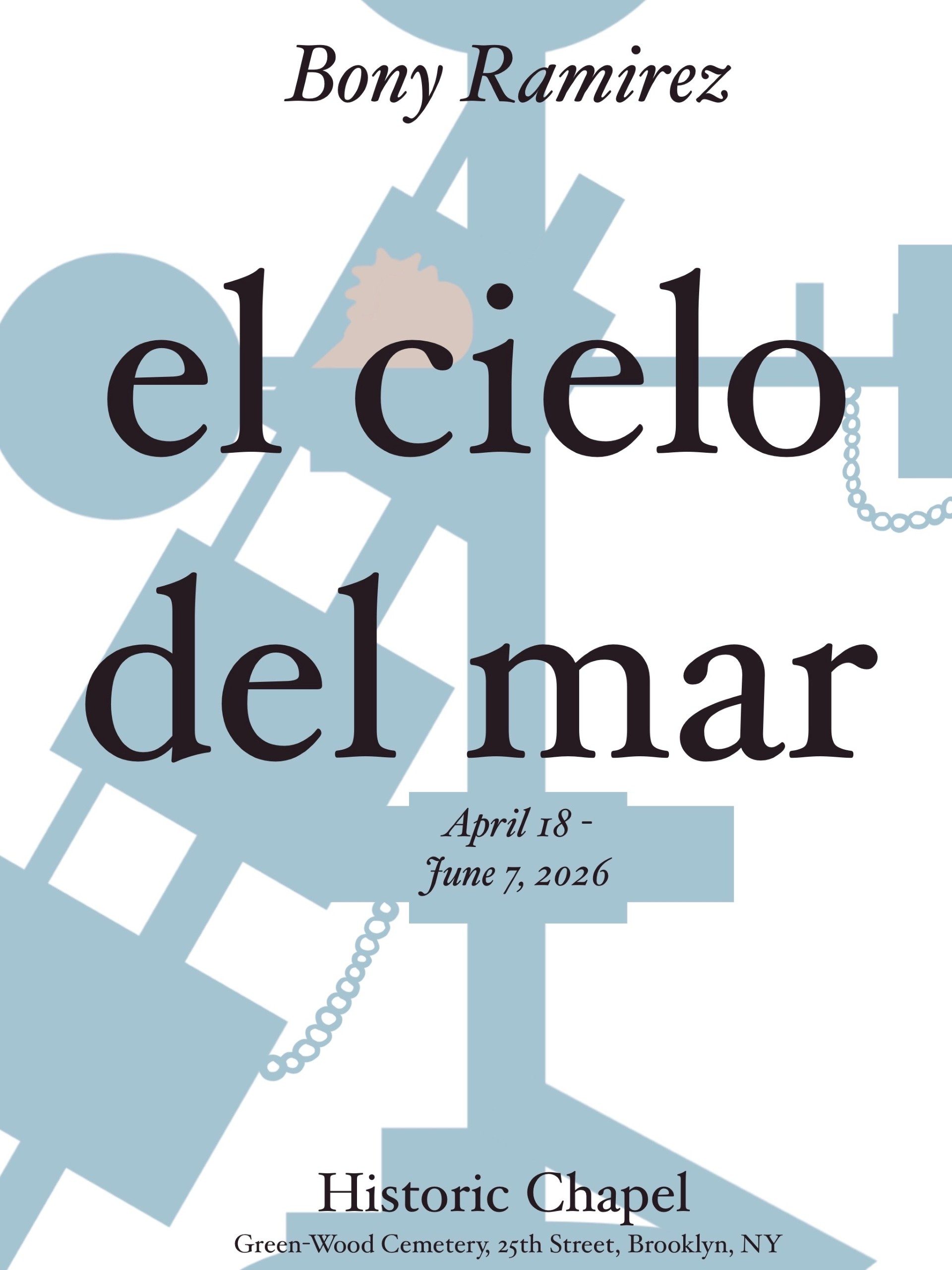
An installation by Bony Ramirez
On view until June 7, 2026, in the Historic Chapel
Para leer en español, consulte a continuación.
A meditation on grief as an inescapable yet transformative condition of life, El Cielo del Mar frames mourning as a passage toward renewal. Drawing on mythological and cultural associations between the sea and the afterlife, the show explores water as a threshold where memory, loss, and spirit connect.
Through immersive sculpture, painting, and sound, the installation creates a collective space for reflection, inviting visitors to engage grief as both a personal and shared process of healing.
Curated by Anne-Laure Lemaitre. Soundscape by Elvin Tavarez. Curatorial support of Harry J. Weil, Vice President of Education and Public Programs.
CURATORIAL STATEMENT
Written by Anne-Laure Lemaitre
Drawing inspiration from secular, mythological, and mythical connections between the sea and the afterlife, El Cielo del Mar offers a space to contemplate one’s relationship to grief. Embracing mourning as an experience of loss and a rite of renewal, in which transformation becomes possible through acknowledgement and surrender.
The exhibition’s title references the inherent healing power of the ocean—particularly in the context of Caribbean culture—and its parallel to a greater beyond. Water operates as a threshold between worlds, a vessel through which memory, history, and spirit circulate. The sea, vast, unknowable, and in constant motion, mirrors the emotional tides of grief.
On the lawn approaching the Historic Chapel stands a large assemblage featuring a reclaimed boat. The outdoor sculpture evokes difficult journeys, from the transience that may come with hardship or displacement to the broader depiction of passage to the afterlife: souls ferried by Charon on the Styx, or navigating from the Nile to Duat, the water-filled underworld. The reclaimed nature of the vessel anchors these mythological references in the lived realities of survival and rupture. Crossing, whether physical or spiritual, is too often marked by both loss and resilience.
The Chapel is occupied by four wooden sculptures. Constructions like these are often used by Bony Ramirez as metaphorical representations of himself in different states of being, but may also be read as referencing four beasts, living creatures, or guardian deities, custodians of the feelings of those who enter. Their presence introduces a subtle tension between protection and confrontation. They may watch over, guide, or bear witness, but also mirror fragmented aspects of the self, allowing viewers to recognize within themselves shifting states of grief, memory, or identity.
On the altar, a large installation composed of a series of panels assembled on multiple planes becomes akin to theater or opera sets, integrating stained glass, marble, carvings, and architecture into the Chapel’s inherent decorative qualities. This layered staging collapses distinctions between the sacred and the constructed, the permanent and the ephemeral, turning the space itself into an active participant in the work. The horse, the structure’s main motif, represents concepts of freedom and journey in many cultures6, but also a connection between realms and the untamed power of the sea. Yet this horse wears blinders, evoking the human struggle to grasp the fleeting nature of life.
Nested at the center of the Chapel, a circular plinth invites visitors to surrender a name or thought connected to their pain or sorrow, under the gaze of sculptures embodying the five stages of grief. This gesture introduces a participatory and ritualistic dimension to the exhibition, transforming viewers into contributors. These anonymous offerings may surrender silent wounds or become gestures of remembrance, creating a collective archive of loss that remains unseen yet deeply present.
Resonating throughout the installation is a companion soundscape designed by artist Elvin Tavarez, which invites introspection, contemplation, and bereavement, enveloping the visitor in an auditory environment, an invisible current that blurs the boundary between inner and outer experience.
El Cielo del Mar was conceived by Ramirez as a safe haven where all are welcome to process their torments and grieve. In doing so, it does not seek to resolve grief, but to hold it, to give it form, space, and temporality, allowing mourning to unfold as both an individual and collective act, and ultimately, as a quiet gesture toward healing and renewal.
ABOUT BONY RAMIREZ
Bony Ramirez was born in 1996 in Tenares, Salcedo, Dominican Republic. He currently works in Jersey City, New Jersey. His rural upbringing in the Dominican Republic, his first encounters with Catholic imagery, and his deep interest in sources as varied as Italian mannerism, Renaissance portraiture, and children’s illustrations reverberate within and around the fictional characters he creates. If each figure appears to be transposed into a changing theatre of symbolic surroundings and backdrops, it is the artist’s technique that renders this possible. Ramirez creates his heavily stylised, proportionally distorted figures on paper and adheres them to wood panels featuring idyllic, colourful backdrops of Caribbean imagery. As Ramirez’s characters, developed separately and simultaneously in oil stick, paint, and coloured pencil, make their way onto his works, so too do various other symbolic appendages. Ramirez uses a variety of objects which either complement the playfulness and idyllicism of his work, such as colourful beads, or contrast it by penetrating it with violence, such as real knives stabbed into the canvas.
Bony Ramirez has exhibited at the Modern Art Museum of Fort Worth (Texas), Bradley Ertaskiran (Montreal), the Newark Museum of Art (New Jersey), François Ghebaly (Los Angeles), Bank/MabSociety (Shanghai), Jeffrey Deitch (New York), among others, and was recognized in the Forbes 30 Under 30 Arts & Style category in 2023, and The Artsy Vanguard 2021. His work has recently been acquired by the permanent collection of the Institute of Contemporary Art Miami, as well as the Boston Museum of Fine Arts, the Newark Museum of Art, the Frye Art Museum, the Perez Art Museum Miami, and the X Museum in Beijing.
EL CIELO DEL MAR
Una instalación de Bony Ramírez
En exhibición hasta el 7 de junio de 2026 en la Capilla Histórica
Una reflexión sobre el duelo como una condición inevitable y, a la vez, transformadora de la vida, El Cielo del Mar propone el luto como un tránsito hacia la renovación. A partir de las asociaciones mitológicas y culturales entre el mar y el más allá, la muestra aborda el agua como un umbral donde convergen la memoria, la pérdida y lo espiritual.
A través de escultura, pintura y sonido en un entorno inmersivo, la instalación construye un espacio colectivo de contemplación. Aquí, el duelo se entiende como una experiencia íntima y, al mismo tiempo, compartida: un proceso de elaboración y cuidado que se transita en compañía.
Curaduría: Anne-Laure Lemaitre
Paisaje sonoro: Elvin Tavarez
Apoyo curatorial: Harry J. Weil, Vicepresidente de Educación y Programas
SOBRE BONY RAMIREZ
Bony Ramírez (n. 1996, República Dominicana; vive y trabaja en Jersey City) desarrolla obras de múltiples capas, informadas por la cultura caribeña, referencias históricas e imaginarios religiosos. Sus composiciones combinan figuras estilizadas con entornos simbólicos de gran intensidad cromática. Con exposiciones a nivel internacional y obra en diversas colecciones, su práctica articula juego y tensión para explorar la narración, la identidad y el mito.